Most cat-back exhaust systems require an inlet diameter between 2.5 in. and 3.5 in. depending on the engine displacement and desired flow characteristics. You should select a diameter that aligns with your vehicle’s factory flow capacity to ensure optimal backpressure and exhaust note.
Recommended Inlet Diameters for Cat-Back Exhaust Systems
| Use Case | Recommended Inlet Diameter | Why this number |
|---|---|---|
| Small Displacement (under 2.5L) | 2.25 in. to 2.5 in. | Maintains high exhaust velocity for better scavenging in smaller engines. |
| Standard Passenger Vehicles (2.5L to 4.0L) | 2.5 in. to 3.0 in. | Balances flow volume with the necessary backpressure for street drivability. |
| Large Displacement / V8 (over 4.0L) | 3.0 in. to 3.5 in. | Provides the high-volume flow required by large cylinders to prevent restriction. |
| High-Performance / Track Use | 3.5 in. and above | Maximizes flow for high-RPM power bands where restriction is the primary concern. |
Products in this category with a full review here
From $132.54 to $1004.95: the 3 in this category we have reviewed in full.

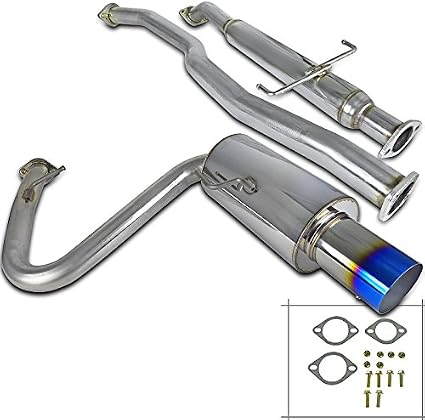
Spec-D Tuning Jdm 2.5″ Inlet Ss Catback
If you own a Honda, check out the best cat back exhaust system for honda civic for performance gains.
$132.54 price checked August 2026

Flowmaster 817669 American Thunder Cat-back Exhaust System
$1004.95 price checked August 2026
Read our full American Thunder Exhaust review
Owners seeking a more aggressive sound can view the best cat back exhaust system for toyota is300 options.
What Happens if You Go Under or Overbuy Inlet Diameter?
Under-provisioning occurs when the inlet diameter is too small for the engine’s output. This creates a physical bottleneck where the exhaust gases cannot exit the manifold or piping quickly enough. You will likely notice a significant increase in exhaust gas temperatures (EGTs) and a noticeable loss of power at the top of the RPM range. Because the gas is being forced through a smaller orifice, the increased backpressure can also lead to a muffled exhaust note and reduced throttle response.
Heat Management and Pressure
When the inlet diameter is too small, the restriction creates a pressure buildup. This pressure can lead to increased heat soak in the exhaust manifold and surrounding components. If the system is pushed to its limit, this heat can degrade nearby heat shields or even affect the longevity of nearby engine components. You should ensure the diameter allows for the volume of gas the engine produces at its highest sustained RPM.
Overbuying occurs when the inlet diameter is significantly larger than what the engine displacement requires. While it may seem like “more is always better,” a diameter that is too large can actually hinder performance in certain engine types. For smaller engines, a massive inlet diameter reduces exhaust gas velocity. If the gas moves too slowly, it loses its ability to “scavenge” the cylinder, which is the process where the exiting gas helps pull the next charge into the combustion chamber.
Exhaust Velocity and Torque
A diameter that is too large can lead to a loss of low-end torque. Because the gas spreads out and loses velocity in a large pipe, the engine may feel sluggish during city driving or initial acceleration. While the top-end power might remain unaffected, the overall drivability of the vehicle can suffer. Choosing a diameter that is too large also increases the physical footprint of the system, which may lead to fitment issues with the chassis or drivetrain.
The Mistake Most Buyers Make with Inlet Diameter
The most common mistake is choosing an inlet diameter based solely on the largest available size rather than the engine’s specific volumetric flow. Many buyers assume that a 3.5 in. inlet will always be better than a 3.0 in. inlet, regardless of whether they are installing it on a 4-cylinder commuter car or a high-performance truck. This leads to the aforementioned velocity losses and unnecessary weight.
Understanding diameter is vital, but you should also consider the ideal pipe wall thickness for cat-back exhausts for durability.
Optimising for Flow Requirements
You should instead focus on the flow requirements of your specific engine displacement. A useful rule of thumb is to look at the factory exhaust dimensions. If the factory system uses a 2.5 in. inlet, a 2.75 in. or 3.0 in. upgrade is often the sweet spot for a balance of improved flow and maintained velocity. You should prioritize a diameter that matches the peak flow requirements of your engine’s power band rather than simply choosing the largest pipe offered in a kit.
How Inlet Diameter Interacts with Other Deciding Specs
Inlet diameter does not exist in a vacuum; it is governed by the internal diameter of the rest of the exhaust system and the material used. If you choose a large inlet diameter but the rest of the cat-back system narrows down significantly, the benefit of the larger inlet is negated by the downstream restriction. The flow must be consistent throughout the system to be effective.
Material and Wall Thickness
The material of the cat-back exhaust system also dictates the maximum diameter you can practically use. Thinner-walled materials like aluminized steel may not support the structural integrity required for very large diameter pipes without significant bracing. If you require a larger diameter for high-flow needs, you may need to consider T304 stainless steel to ensure the system maintains its shape and weld integrity under high heat and vibration.
Fitment and Clearance Constraints
Physical space is often the ultimate limit on inlet diameter. Even if your engine requires a 3.5 in. diameter for optimal flow, the space between the frame rails or the drivetrain components may only allow for a 3.0 in. pipe. You must confirm your vehicle’s clearance before selecting a diameter. If the space is tight, you may have to accept a slightly smaller diameter to ensure the system can be mounted safely without interfering with moving parts or heat-sensitive components.
Limits of Our Research
We do not have data on specific vehicle-specific clearance tolerances or exact flow coefficients for every individual engine manufacturer. You should verify the exact clearance of your vehicle’s chassis with a physical measurement before ordering a system with a specific inlet diameter.