Most cat-back exhaust systems require an outlet diameter between 2.5 in. and 3.5 in. depending on engine displacement and desired exhaust note. You should select a diameter that aligns with your engine’s flow requirements to balance performance with noise levels.
Recommended Outlet Diameters for Cat-Back Exhaust Systems
| Use Case | Recommended Outlet Diameter | Why this number |
|---|---|---|
| Daily Driver / Commuter | 2.25 in. to 2.5 in. | Maintains fuel efficiency and keeps exhaust noise at a civil level for street use. |
| Sport Performance / Street | 2.5 in. to 3.0 in. | Provides a balance of increased flow for mid-range torque and a deeper exhaust note. |
| High-Performance / Track | 3.0 in. to 3.5 in. | Allows maximum gas evacuation for high-horsepower engines and high-RPM operation. |
| Heavy Duty / Diesel | 3.5 in. to 4.0 in. | Necessary to move the high volume of exhaust gas produced by large displacement engines. |
Products in this category with a full review here
From $132.54 to $1004.95: the 3 in this category we have reviewed in full.
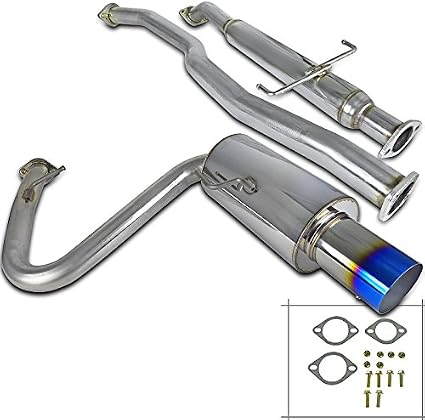

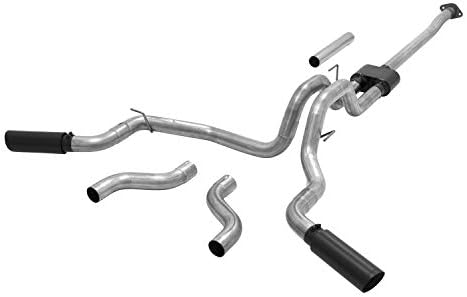
Flowmaster 817726 Outlaw Cat-Back Exhaust Kit
$659.99 price checked August 2026
Read our full Flowmaster Outlaw Kit review
If you own a truck, you can find our guide on selecting the best cat back exhaust system for ford f-150 to see the top-performing options.
What Happens if You Under-Size or Over-Buy Outlet Diameter?
Under-sizing the outlet diameter occurs when the pipe is too narrow for the engine’s output. This creates excessive backpressure, which can lead to higher exhaust gas temperatures and a loss of power at high RPMs. You may notice the engine feels “choked” or sluggish under heavy acceleration because the gas cannot exit the system fast enough.
Risks of Under-Sizing the Cat-Back Exhaust
When the outlet diameter is too small, the velocity of the exhaust gases increases significantly. This high velocity can cause a drone frequency—a persistent resonance—at specific highway speeds. It can also lead to heat soak, where the exhaust system retains more heat than intended, potentially affecting nearby components or the cabin’s ambient temperature.
The Real Cost of Over-Buying Outlet Diameter
Over-buying involves installing an outlet diameter that is significantly larger than what the engine can fill with gas. While many believe larger is always better, an oversized pipe can actually decrease low-end torque. Because the exhaust gas velocity drops, the “scavenging” effect—where the vacuum of exiting gas helps pull more gas out of the cylinder—becomes less efficient.
Furthermore, over-buying results in a much louder exhaust note. A larger diameter allows more sound waves to pass through with less restriction, which can lead to a harsh, raspy tone rather than a deep growl. You also face a higher cost for the material and increased weight of a larger diameter pipe without a proportional gain in performance.
The Mistake Most Buyers Make with Outlet Diameter
The most common mistake buyers make is assuming that a larger outlet diameter automatically translates to more horsepower. Many users believe that if a 3.5 in. pipe is “faster” than a 2.5 in. pipe, then the 3.5 in. pipe is the objectively better choice for every vehicle.
Optimising for Torque Instead of Flow
You should be optimising for the engine’s power band rather than just the maximum flow capacity. For most street-driven vehicles, the goal is to maintain enough velocity to keep the exhaust gases moving efficiently. If the pipe is too large, the engine loses the ability to pull exhaust out effectively at lower RPMs where most daily driving occurs.
Instead of looking for the largest number available, identify the maximum power your engine produces and choose a diameter that supports that output without sacrificing the scavenging effect. A 2.5 in. or 3.0 in. system is often the “sweet spot” for performance engines because it provides sufficient flow while maintaining the gas velocity needed for responsive throttle feel.
How Outlet Diameter Interacts with Other Cat-Back Exhaust Specs
Outlet diameter does not exist in a vacuum; it interacts directly with pipe wall thickness and material composition. A larger diameter often requires a thicker wall to maintain structural integrity under high heat and vibration.
Material Standards and Diameter
The material of the cat-back exhaust, such as T304 Stainless Steel, determines how the diameter behaves under heat cycling. Thinner-walled tubing in a large diameter can become prone to deformation or weld failure. If you choose a larger diameter, you must ensure the material grade is sufficient to handle the increased surface area and the resulting heat distribution.
Flow Limitations of the Upstream System
The outlet diameter is only as effective as the upstream components allow. If your vehicle retains a restrictive stock catalytic converter or a narrow mid-pipe, a massive outlet diameter will provide no benefit. The flow is limited by the narrowest point in the system; therefore, the outlet diameter should be sized to complement the flow capacity of the rest of the exhaust path.
Fitment Clearance and Bending Geometry
Outlet diameter also dictates the bend radius and fitment clearance of the cat-back system. A larger diameter pipe requires a larger turning radius to clear the drivetrain and chassis components. If the diameter is too large for the available space, the installer may have to use sharper bends, which creates turbulence and negates the flow benefits of the larger pipe. You must confirm that the chosen diameter allows for smooth, sweeping curves that maintain the integrity of the exhaust flow.
Before ordering, you must confirm that the chosen diameter provides enough clearance for your specific vehicle’s rear subframe and suspension components. Because fitting a cat-back system is a job for a qualified installer, providing them with the correct diameter ensures the system can be mounted without compromising the structural integrity of the welds or the clearance of the drivetrain.