In car suspension, technical terms often split into two categories: load-bearing specifications and marketing vocabulary. Load-bearing terms describe physical dimensions, material grades, and mechanical limits that determine if a part will fit your vehicle or survive a heavy load. Marketing vocabulary often describes subjective “feel” or vague performance claims. To find the right parts, you should prioritize measurable data like spring rates, travel limits, and mounting patterns over descriptive adjectives like “smooth” or “sporty.”
Car Suspension Performance and Capability Terms
Car suspension performance depends on how the system manages energy and weight. These terms define the physical limits of what the hardware can do.
- Spring Rate – This is the amount of force required to compress a spring by one inch. A higher spring rate provides a stiffer ride and better handling for heavy loads, while a lower rate offers a softer, more compliant ride for passenger comfort.
- Ride Height – This is the distance between the center of the wheel and the ground. Increasing ride height provides more ground clearance for off-road use, while decreasing it lowers the center of gravity for better high-speed stability.
- Travel – This measures the total distance a shock absorber or strut can compress and rebound. More travel allows the suspension to absorb larger bumps without hitting the mechanical limits of the hardware.
- Damping Force – This is the resistance provided by the shock absorber to control the speed of the spring’s movement. Higher damping forces reduce body roll and “bouncing,” but excessively high damping can make the ride feel harsh over small bumps.
- Progressive Rate – This describes a spring that becomes stiffer as it compresses further. A progressive rate allows for a soft ride during normal driving while providing extra support during heavy cornering or when the vehicle is fully loaded.
- Bypass Technology – This is a mechanism that allows the shock absorber to have different damping rates at different points in its travel. More bypass zones allow for a plush ride initially while providing extreme resistance at the end of the stroke to prevent bottoming out.
Where these choices show up in our reviews
These 3 have their own full review on this site, and run from $160.76 to $449.99.

MILLISEC Air Ride Suspension Compressor Pump
$195 price checked August 2026
Read our full Air Ride Compressor review
If you need to upgrade your height, compare the best suspension repair kit for truck lift to see which parts fit your needs.
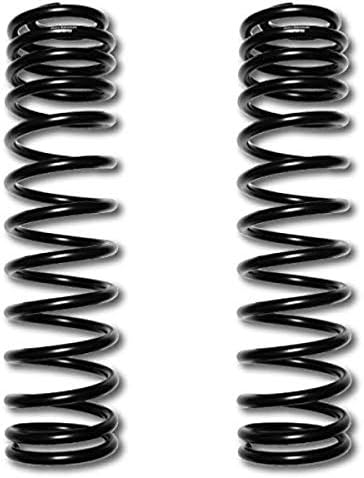

SUPERLIFT Suspension Component Box 3377
$449.99 price checked August 2026
Read our full SUPERLIFT Component Box review
Understanding your specific vehicle requires you to learn about the different types of car suspensions available today.
Car Suspension Physical and Material Terms
Car suspension physical terms describe the construction of the parts. These specifications ensure the hardware can withstand the stresses of operation without failing.
- Coil Spring – This is a spiral of metal wire that stores energy when compressed. These are the standard for most passenger cars due to their compact size and predictable spring rates.
- Leaf Spring – These are curved plates of metal layered on top of each other. Leaf springs offer high load capacity and durability for heavy-duty trucks, though they generally provide a stiffer ride than coil springs.
- Nitrogen Gas Charge – This refers to pressurized gas used inside a shock absorber to prevent oil foaming. A higher nitrogen charge helps maintain consistent damping performance during high-frequency impacts or heavy-duty use.
- 18/10 Stainless Steel – This is a grade of steel containing 18% chromium and 10% nickel. This material provides high corrosion resistance and strength, making it suitable for components exposed to road salt and moisture.
- Bushings – These are rubber or polyurethane inserts that sit between metal components. Softer bushings provide a quieter, more compliant ride, while firmer bushings improve steering precision by reducing movement between parts.
- Bump Stop – This is a physical buffer (often rubber or polyurethane) that prevents the suspension from bottoming out. A larger bump stop provides a more gradual transition at the end of the suspension’s travel.
Car Suspension Compatibility and Fitment Terms
Car suspension compatibility terms ensure the parts will physically bolt onto your vehicle. These are the most critical specs to verify before ordering.
- Bolt Pattern – This is the specific spacing and number of holes used to mount the suspension to the vehicle frame. The bolt pattern must match your vehicle’s factory geometry exactly for the parts to be installed.
- Strut Mount – This is the top point where the shock absorber attaches to the vehicle’s chassis. If the mount does not match your vehicle’s specific geometry, the suspension will not align correctly.
- Knuckle Clearance – This is the amount of space available between the suspension components and the steering knuckle. You must ensure that any aftermarket parts have enough clearance to move freely without hitting the brake assembly or steering linkage.
- Caster and Camber – These are the angles at which the wheels tilt. Caster affects steering stability, while camber affects tire wear and cornering grip. If an aftermarket kit changes these beyond the manufacturer’s limits, it can lead to accelerated tire wear.
- OEM Fitment – This indicates that a part is designed to replace the original equipment used by the vehicle manufacturer. OEM fitment ensures the part uses the same mounting points and geometry as the factory parts.
Commonly Confused Suspension Terms
Several terms in car suspension are often confused by buyers, but they describe different mechanical functions.
Shock Absorber vs. Strut
A shock absorber is a standalone component that only controls the speed of the spring’s movement. A strut is a structural component that combines the shock absorber, a coil spring, and a mounting point into a single unit that supports the weight of the vehicle.
Spring Rate vs. Ride Height
Spring rate refers to the stiffness of the metal coil (force per inch). Ride height refers to the physical distance the vehicle sits off the ground. You can have a high spring rate that results in a low ride height, or a low spring rate that results in a high ride height.
Camber vs. Caster
Camber is the inward or outward tilt of the top of the tire when viewed from the front. Caster is the forward or backward tilt of the steering axis when viewed from the side. Camber primarily affects tire wear and grip during cornering, while caster affects the “return to center” feel of the steering wheel.
Reviewed by the ExtremeSpec Auto editorial team. ExtremeSpec Auto writes these guides from the 8 most-reviewed car suspension listings in our retail dataset, not from manufacturer copy.