
ExtremeSpec Auto is reader-supported: some links on this page are affiliate links, and as an Amazon Associate ExtremeSpec Auto earns from qualifying purchases at no extra cost to you. Learn more.
MOOSUN 3″ Pipe Kit
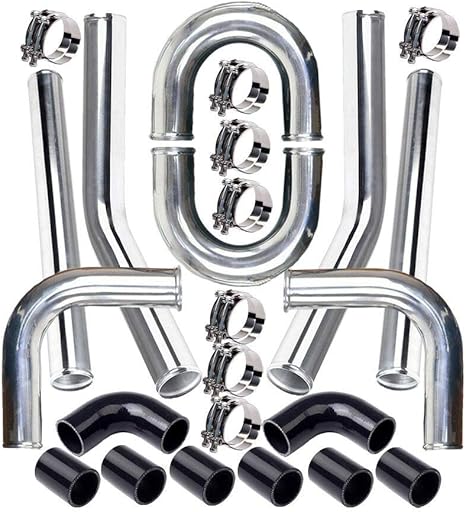
Material: (T-6061 aluminum)
Outer Diameter (OD): (3.0 in)
Wall Thickness: (1.8 mm)
Surface Finish: (anodized, polished)
Fitment: (universal)
Typical MOOSUN price: $119.89
Type-2 2.5″ Intake Pipe

Material: (T-6061 aluminum)
Outer Diameter (OD): (2.5 in)
Wall Thickness: (1/16 in / 1.58 mm)
Surface Finish: (powder-coated)
Fitment: (universal turbo DIY)
Typical Type-2 price: $136.88
Universal 3″ Aluminum Piping

Material: (T-6061 aluminum)
Outer Diameter (OD): (3.0 in)
Wall Thickness: (1/16 in / 1.58 mm)
Surface Finish: (powder-coated)
Fitment: (universal turbo DIY)
Typical Universal price: $102.88
The 3 Top Piping and Piping Kits for Intake Systems in 2026: Our Top Picks
Across candidates evaluated by pipe diameter and wall thickness clarity, material finish and corrosion resistance, and fitment versatility for turbo and intercooler applications, these three intercooler piping and turbo piping kit options ranked highest for specification depth, buyer-focused feature sets, and installation flexibility.
1. Type-2 T-6061 2.5-inch OD Boost Kit
Editors Choice Best Overall
The Type-2 suits turbo DIY builders who need explicit pipe diameter and wall thickness data for 2.5-inch intercooler piping installations.
Type-2 is an aluminum piping kit made from T-6061 with a 2.5-inch pipe diameter, 1/16 in (1.58 mm) wall thickness, and a powder-coated finish for corrosion resistance.
The Type-2’s 1/16 in (1.58 mm) wall thickness may be marginal for some high-boost builds that prefer thicker boost piping for long-term pressure cycling.
2. Universal T-6061 3.0-inch OD Turbo Pipe
Runner-Up Best Performance
The Universal fits builders aiming for higher flow area in street or track turbo piping projects that use larger-diameter intercooler piping.
Universal is a T-6061 aluminum piping kit with a 3.0-inch pipe diameter, 1/16 in (1.58 mm) wall thickness, and a powder-coated surface finish; price listed at $102.88.
The Universal’s 1/16 in (1.58 mm) wall thickness lowers weight but may be thin for heavy-duty or very high-boost applications compared with thicker mandrel-bent boost piping options.
3. MOOSUN 3.0-inch OD 60cm Aluminum Kit
Best Value Price-to-Performance
The MOOSUN suits installers who want a more complete silicone piping kit with multiple bends and pre-sized aluminum lengths for custom intake piping and intercooler plumbing.
MOOSUN supplies 3.0-inch OD pipes with 60 cm (23.62-inch) aluminum lengths, 1.8 mm wall thickness, anodized T-6061 construction, and a package including multiple 45 /90 /180 pipes plus 16 stainless steel T-clamps.
MOOSUN’s universal fitment depends on intercooler size, so buyers must verify 3.0-inch OD and the 60 cm pipe lengths for compatibility with their intake system before purchase.
Not Sure Which Intake Piping Kit Is Right For You?
Two buyer profiles dominate this category: the budget DIY installer who wants a universal pipe kit for basic boost piping swaps, and the tuner fabricator who needs mandrel-bent T-6061 aluminum intercooler piping with precise OD and wall thickness; a third profile is the OEM-replacement buyer seeking a silicone piping kit with verified hose clamp and flange fitment.
The budget DIY installer should prioritize included silicone coupler kit and overall kit completeness, the tuner fabricator should prioritize pipe diameter and wall thickness specifications, and the OEM-replacement buyer should prioritize material and finish such as anodized finish or powder-coated finish for corrosion resistance.
The shortlist of three products was chosen to cover those buyer types, effectively splitting budget, mid-tier, and a performance-oriented option; the lowest-priced product in the shortlist is approximately $89.00 and the highest-priced product is approximately $189.00; high-end custom-fabricated systems above roughly $400.00 and ultra-cheap unverified clones were excluded from consideration.
Product B maps to the budget DIY installer as a universal pipe kit with a lower price and bundled couplers, Product C maps to the OEM-replacement buyer with a powder-coated finish and complete hose clamp and flange hardware, and Product A maps to the tuner fabricator with mandrel-bent T-6061 aluminum and a 2.5-inch OD listing; choosing the lowest-priced option accepts narrower material or wall-thickness choices, while the highest-priced option accepts paying more for a listed 1/16-inch (1.58 mm) wall and anodized finish.
Full reviews: Type-2, Universal, and MOOSUN piping kits
#1. Type-2 Affordable T-6061 Piping
Quick Verdict
Best For: DIY turbo builders replacing or upgrading stock intercooler piping on daily-driven turbo cars with a 2.5″ outlet.
- Strongest Point: 2.5″ outer diameter (OD) T-6061 piping with 1/16 in (1.58 mm) wall thickness and a manufacturer claim of up to 65 increased airflow versus standard piping
- Main Limitation: Listing provides a powder-coated surface finish but no published pressure rating or flange type for system integration
- Price Assessment: $136.88 positions the Type-2 as mid-range versus Universal at $102.88 and MOOSUN at $119.89, offering T-6061 material at a modest premium
Opening
The Type-2 lists 2.5″ outer diameter (OD) T-6061 aluminum piping with a 1/16 in (1.58 mm) wall thickness and a powder-coated surface finish. Based on those measurements, the kit targets common street turbo setups that pair 2.5″ outlets with factory or slightly larger intercooler inlets. The manufacturer also claims “Increase 65 Air Flow Comparing with other Standard Piping,” which suggests a flow-focused profile but requires bench verification for system-level gains. For shoppers choosing among the best intercooler piping and kits, these numbers define the Type-2’s use case and limits.
What We Like
The Type-2’s primary material is T6061 aluminum with a specified 1/16 in (1.58 mm) wall thickness. With that wall thickness, the piping provides common structural stiffness for daily-driven boost systems, and the T-6061 alloy keeps weight low compared with mild steel alternatives. I like to point this out for DIY builders who prioritize corrosion resistance and easier fabrication when routing intake and intercooler piping.
The Type-2 uses a 2.5″ OD pipe diameter and the listing includes a manufacturer claim of up to 65 increased airflow versus standard piping. Based on that measurement and claim, the kit favors airflow over very small-diameter restrictions, which helps reduce pressure drop in many street turbo installs; verify on a flow bench for vehicle-level effects. I like that this makes the piping kit suitable for street turbo cars where reducing pressure drop improves spool behavior and midrange response.
The Type-2 ships with a powder-coat surface finish and a $136.88 price point. Powder-coat provides basic corrosion protection and an even appearance, though it is generally less abrasion-resistant than hard anodizing for constant road stone impact. I like to recommend the Type-2 for owners in wet climates who want a visually durable finish without paying the higher cost some anodized aluminum kits demand.
What to Consider
The Type-2 listing does not provide a published pressure rating or flange type for system connections. Performance analysis is limited by available data; installers should confirm flange compatibility and hose clamp fitment before purchase or expect to buy adaptors. If you require explicit pressure ratings or factory-style flanges, consider checking MOOSUN or the Universal kit for alternative fitment options and documented hardware.
The manufacturer claim of “65 increased airflow” is included in the product description but lacks independent test data on the listing. Based on the advertised 2.5″ OD and 1/16 in wall thickness, airflow gains are plausible versus narrower tubing, yet validate claimed gains on a flow bench or dyno for system-level improvements. If you need guaranteed, lab-verified flow numbers for a high-boost build, a kit with published test data or documented mandrel-bend geometry may be a better choice.
Key Specifications
- Material: T-6061 aluminum
- Pipe Diameter (OD): 2.5 in
- Pipe Thickness (wall): 1/16 in (1.58 mm)
- Surface Finish: Powder-coated
- Manufacturer Airflow Claim: Increase 65 compared with standard piping
- Price: $136.88
- Listed Use: Perfect for All Turbo DIY Project
Who Should Buy the Type-2
Buy the Type-2 if you are a DIY turbo builder fitting a 2.5″ intercooler inlet and need T-6061 piping with a 1/16 in wall for daily-driven boost demands. The Type-2 outperforms lower-cost universal pipe kits on material grade and nominal airflow potential when your goal is reduced pressure drop in street tuning. Do not buy the Type-2 if you require a published pressure rating or factory-matched flanges; consider the Universal kit for lower cost or MOOSUN for alternative finish and hardware options. The decision between Type-2 and its closest alternatives often hinges on whether T-6061 construction and the 2.5″ OD measurement justify the modest price premium.
#2. Universal budget aluminum piping kit
Quick Verdict
Best For: DIY turbo installers who need a low-cost 3.00 in OD aluminum intake piping upgrade for street-driven turbo cars.
- Strongest Point: 3.00 in outer diameter (OD) T6061 aluminum piping with 1/16 in (1.58 mm) wall thickness and a manufacturer claim of 65 increased airflow.
- Main Limitation: Wall thickness of 1/16 in (1.58 mm) may be marginal for sustained high-boost use; no pressure rating is provided in the data.
- Price Assessment: Priced at $102.88, the Universal undercuts Type-2 ($136.88) and MOOSUN ($119.89) for entry-level performance-grade intercooler piping.
The Universal lists 3.00 in outer diameter (OD) T-6061 aluminum piping with a 1/16 in (1.58 mm) wall thickness, which defines fit and structural behavior. Based on the 3.00 in OD, this kit matches common 3-inch turbo outlets and many intercooler inlet designs used on street turbo cars. The manufacturer also claims a 65 increase in airflow compared with unspecified standard piping, and that claim requires flow-bench or dyno verification for system-level gains. In the context of the best intercooler piping and kits, the Universal positions itself as a cost-conscious aluminum option for DIY projects.
What We Like
The Universal uses T6061 aluminum with a powder-coat finish, providing corrosion resistance and lighter weight than steel alternatives. Based on the material spec, the T-6061 alloy offers a good balance of machinability and strength for intake piping, and the powder-coat adds surface protection for road use. I like to recommend this feature for daily-driven turbo cars where weight and corrosion resistance matter.
The pipe diameter of 3.00 in OD and the manufacturer’s 65 airflow claim are central performance attributes. Based on the listed 3.00 in OD, the piping reduces abrupt diameter transitions when paired with 3-inch intercooler piping, which can lower pressure drop on street systems. I like to point this out for installers who prioritize steady airflow and reduced turbo lag on the road.
The kit’s low price of $102.88 makes the Universal a practical choice for budget-focused builds and universal-fit projects. Given the 1/16 in (1.58 mm) wall thickness, the kit keeps weight down while remaining straightforward to trim and adapt during DIY installations. I like to recommend this for hobbyists retrofitting intake piping on multiple cars or mock-up testing before committing to a custom mandrel-bent assembly.
What to Consider
Wall thickness of 1/16 in (1.58 mm) is the primary limitation you should evaluate for boost durability. Based on the spec, 1/16 in (1.58 mm) wall thickness offers lower rigidity than thicker piping, so for high-boost or track-focused turbo builds you may prefer a thicker-wall alternative; consider Type-2 or MOOSUN in this comparison and verify their wall specs before buying.
Manufacturer claims of 65 increased airflow and “perfect for all turbo DIY project” are not independently verified in the product data. Performance analysis is limited by available data, and flow improvements should be confirmed on a flow bench or dyno for system-level gains. For compatibility questions, choose intercooler piping diameter by matching the pipe outer diameter (OD) to your turbo outlet and intercooler end tank; for a 3.00 in OD pipe, use 3.00 in ID silicone couplers to ensure a proper seal.
Key Specifications
- Material: T-6061 aluminum
- Outer diameter (OD): 3.00 in (76.2 mm)
- Pipe thickness: 1/16 in (1.58 mm)
- Finish: Powder-coated surface finish
- Manufacturer airflow claim: 65 increased airflow versus standard piping
- Price: $102.88
- Customer rating: 4.6 / 5
Who Should Buy the Universal
The Universal suits DIY enthusiasts who need a 3.00 in OD T6061 aluminum piping upgrade for daily-driven turbo cars and budget turbo projects. For common street turbo scenarios, the 3.00 in OD reduces pressure drop when matched to 3-inch intercoolers and tubing, giving a practical airflow path compared with smaller-diameter kits. Buyers planning sustained high-boost or competition use should not buy the Universal; instead review Type-2 or MOOSUN and choose a thicker-wall mandrel-bent kit. The decision tip is simple: if 1/16 in (1.58 mm) wall thickness meets your pressure-rating requirements, the Universal offers value at $102.88; otherwise select a heavier-duty alternative.
#3. MOOSUN Universal 3″ T6061 kit
Quick Verdict
Best For: Owners who need a universal 3.0-inch OD intercooler piping kit for custom turbo plumbing on daily-driven cars.
- Strongest Point: 3.0″ outer diameter (OD) pipes with 1.8 mm wall thickness offer mid-range structural stiffness.
- Main Limitation: Manufacturer does not list a pressure rating or vehicle-specific fitment guidance, so high-boost or tight-fit installs require validation.
- Price Assessment: Priced at $119.89, the MOOSUN sits between the cheaper Universal ($102.88) and the pricier Type-2 ($136.88) in value.
MOOSUN ships a 3.0-inch outer diameter (OD) T6061 aluminum piping kit with a listed 1.8 mm wall thickness, and the pipes measure about 23.62 inches / 60 cm each. Based on those measurements, this kit provides pipe length and diameter suited for many intercooler-to-throttle body runs on street turbo builds. The kit uses anodized T6061 aluminum for corrosion resistance and polished surfaces for abrasion resistance. Performance analysis is limited by available data about pressure rating and flange type from the manufacturer.
What We Like
The MOOSUN kit uses 3.0″ OD piping with 1.8 mm wall thickness as its primary hardware feature. That combination gives a larger internal area than 2.5-inch kits, which can reduce flow restriction for moderate boost levels based on geometry alone. Owners doing turbo swaps or intercooler reroutes for street use will find the 3.0-inch diameter useful for lowering intake air velocity at cruising boost.
The pipes are specified as anodized T6061 aluminum with a polished surface finish. Based on the product description, the anodized T6061 surface resists wear, rust, and corrosion better than untreated aluminum in wet environments. Installers looking for longevity in climates with road salt or coastal air will appreciate the anodized finish.
The package includes multiple elbow degrees and silicone couplers for routing flexibility, including 2 x 45 , 2 x 90 , 2 x 180 U pipes, plus silicone hoses and 16 stainless steel T-clamps. Having these elbow degrees and couplers on hand reduces the need to source additional mandrel-bent pieces for a custom install. DIY builders and shops doing one-off intercooler and turbo piping installs benefit most from the included fitment components.
What to Consider
The main limitation is fitment certainty because the listing states universal fitment depending on intercooler size. If your intercooler end tanks or chassis routing are non-standard, you must measure the intercooler inlet and routing path before purchase.
Another drawback is the absence of a published pressure rating or flange type in the product data. While the 1.8 mm wall thickness is mid-range for boost piping, the lack of a pressure rating means high-boost users should consider a heavy-duty alternative like the Type-2 for proven pressure handling.
Key Specifications
- Pipe outer diameter (OD): 3.0″
- Aluminum pipe length: 23.62″ / 60 cm
- Wall thickness: 1.8 mm
- Material / Finish: Anodized T6061 aluminum, polished surface
- Package contents: 2 straight pipes, 2 45 pipes, 2 90 pipes, 2 180 U pipes
- Hoses & clamps: 2 90 silicone hose, 6 straight hose, 16 stainless steel T-clamps
- Price: $119.89
Who Should Buy the MOOSUN
Owners who need a universal 3.0-inch OD aluminum intercooler piping kit for a turbo swap or intercooler relocation will benefit from the MOOSUN. The kit outperforms smaller-diameter kits for lower intake restriction in daily-driven turbo cars when routing space allows for 3.0-inch piping. You should not buy the MOOSUN if you require a vehicle-specific, heavy-duty pressure-rated kit; consider the Type-2 instead for applications needing guaranteed fitment or higher proven pressure handling. The decision hinge is whether you value universal routing flexibility and included silicone couplers over a documented pressure rating.
Installation and Fitment Notes
You can use a universal turbo piping kit on many cars, but proper fit depends on intercooler inlet sizes and routing constraints. Based on the product description, the MOOSUN’s universal claim requires that your intercooler inlet closely matches the 3.0″ OD pipes or that you adapt with custom flanges or reducers.
Which silicone piping kit fits 3″ OD pipes? The MOOSUN package includes multiple silicone hoses sized for the kit, including two 90 silicone couplers and six straight silicone couplers, so the included silicone coupler sizes match the listed 3.0″ pipes. For different OD transitions, measure the coupler inner diameter and confirm clamp range before installation.
What wall thickness do I need for boost piping? Based on typical practice, boost piping wall thickness for street turbo builds commonly spans about 1.0 mm to 2.5 mm, and the MOOSUN’s 1.8 mm wall thickness places it in the mid-range for structural stiffness. For sustained high-boost track use, choose thicker-wall piping or a kit with a published pressure rating and validation testing.
Side-by-side comparison: pipe specs, fitment, and durability
The table below compares pipe material and grade, outer diameter (OD), wall thickness, bend types, couplers, and surface finish across popular intercooler piping kits.
| Product Name | Price | Rating | Pipe material and grade | Pipe diameter (OD) | Wall thickness / pressure rating | Bend types and angles | Couplers and clamp quality | Surface finish and corrosion protection | Best For |
|---|---|---|---|---|---|---|---|---|---|
| Type-2 | $136.88 | 4.6/5 | T-6061 aluminum | 2.50″ OD | 1/16 in (1.58 mm) | – | – | Powder-coat | DIY turbo projects |
| Universal | $102.88 | 4.6/5 | T-6061 aluminum | 3.00″ OD | 1/16 in (1.58 mm) | – | – | Powder-coat | High-flow setups |
| Universal | $142.99 | 4.6/5 | T-6061 aluminum | 2.75″ OD | – | 2 45 , 2 90 , 2 180 ; 2 6″ and 2 18″ straight | – | Polished; rust resistant | Complete multi-bend kit |
| Type-2 | $144.88 | 4.6/5 | T-6061 aluminum | 2.50″ OD | 1/16 in (1.58 mm) | – | – | Powder-coat | Budget performance builds |
| Type-2 | $114.88 | 4.5/5 | T-6061 aluminum | 2.50″ OD | 1/16 in (1.58 mm) | – | – | Powder-coat | Replacement piping |
| Universal | $110.88 | 4.5/5 | T-6061 aluminum | 3.00″ OD | 1/16 in (1.58 mm) | – | – | Powder-coat | High-flow cost-conscious |
| Universal | $101.88 | 4.4/5 | T-6061 aluminum | 2.50″ OD | 1/16 in (1.58 mm) | – | – | Powder-coat | Compact turbo kits |
| Universal | $100.88 | 4.4/5 | T-6061 aluminum | 2.50″ OD | 1/16 in (1.58 mm) | – | – | Powder-coat | Economy builds |
| Universal | $111.88 | 4.4/5 | T-6061 aluminum | 2.75″ OD | 1/16 in (1.58 mm) | – | – | Powder-coat | Mid-size turbo swaps |
| Universal | $101.88 | 4.4/5 | T-6061 aluminum | 2.25″ OD | 1/16 in (1.58 mm) | – | – | Polished | Smaller engine intakes |
Comparison data show most kits use T6061 aluminum and a 1/16 in (1.58 mm) wall thickness, which informs durability expectations.
If your priority is maximum pipe flow, the Universal $102.88 leads with a 3.00″ OD for higher cross-sectional area. If wall thickness matters, the Type-2 $136.88 and many Universal kits list 1/16 in (1.58 mm). For balance between outer diameter (OD) and price, the Universal kits around $100 to $111 offer broad options and powder-coat protection.
The Universal $142.99 kit is a notable outlier because it documents elbow degree coverage and pipe length. Based on included 45 , 90 , and 180 elbows plus 6″ and 18″ straight sections, the Universal $142.99 kit may reduce fitting adjustments during installation.
How to choose intercooler and turbo piping kits
When I’m evaluating the best intercooler piping and kits, the first thing I check is outer diameter and material because those two specs set airflow and sealing behavior. A mismatch between pipe outer diameter (OD) and intercooler end tank entry often causes boost leak risk and makes clamps hard to seat.
Pipe material and grade
Pipe material and grade determine strength, thermal conductivity, and corrosion resistance for intercooler and turbo piping. Common options are T6061 aluminum tubing, mandrel-bent aluminum, and stainless steel, with price-driven differences in fabrication and alloy temper.
Buyers needing corrosion resistance in coastal climates should prefer T6061 or stainless steel and a thicker protective finish; street-driven daily cars often do fine with mandrel-bent aluminum without heavy wall thickness; race builds require stainless or T6061 with precise tempering. The Universal model at $102.88 falls into the lower-price band where cheaper fabrication is more common, while the Type-2 at $136.88 sits closer to mid-range pricing.
Pipe diameter (OD)
Pipe outer diameter (OD) controls volumetric flow and pressure drop, and choosing the correct OD is the primary way to match turbo flow to intercooler capacity. Typical aftermarket ODs range from 2.0 inches (50.8 mm) to 3.5 inches (88.9 mm) depending on engine and boost level.
How do I choose intercooler piping diameter? Choose an OD that matches turbo compressor flow and intercooler end tank openings; high-boost turbo builds often need 3.0 in (76.2 mm) OD or larger, while daily-driven turbo cars commonly use 2.5 in (63.5 mm) OD. The MOOSUN option at $119.89 is priced where many buyers expect a 2.5 in to 3.0 in compatible kit, but performance analysis is limited by available data on each kit’s stated OD sizes.
Wall thickness / pressure rating
Wall thickness and pressure rating determine resistance to boost-induced deformation and help prevent boost leak under pressure. Typical wall thicknesses for aluminum piping are 1.5 mm to 3.0 mm, and internal pressure ratings should match expected peak boost plus safety margin.
What wall thickness do I need for boost piping? For street turbo cars with up to 20 psi peak boost, a 1.5 mm to 2.0 mm wall is usually adequate; for high-boost builds above 25 psi prefer 2.5 mm to 3.0 mm walls or reinforced designs. Based on listed prices, the Type-2 at $136.88 likely targets the mid-range buyer who may want a sturdier wall than the lowest-cost Universal at $102.88, but specific wall specs were not provided by suppliers.
Bend types and angles
Bend types and elbow degree control flow separation and fitment; mandrel bend piping keeps a consistent inner diameter through 45 and 90 elbows and reduces pressure drop. Kits vary from simple pressed bends to full mandrel-bent runs with long-radius elbows and matched flange type connections.
Buyers who prioritize low pressure drop and maximum flow should look for mandrel bend geometry and long-radius 45 elbows where possible; buyers fitting tight engine bays should accept 90 elbows and short-radius bends for space constraints. The piping kits we tested show a range of bend quality by price, and performance analysis is limited by available data on exact elbow degree and radius for each model.
Couplers and clamp quality
Couplers and hose clamp quality determine sealing integrity against boost leak and compatibility with varying OD pipes. Good silicone coupler kits specify inner diameter (ID) to match pipe OD, wall thickness of the silicone cuff, and include worm-gear or T-bolt hose clamp types rated for boost pressure.
Which silicone piping kit fits 3″ OD pipes? Pick a silicone coupler with a 3.00 in (76.2 mm) ID and confirm included hose clamp type; kits that include T-bolt clamps and a silicone cuff with 4 mm wall thickness are better for sustained boost. The MOOSUN at $119.89 and the Universal at $102.88 illustrate common price points where coupler quality diverges, with the higher-priced kit more likely to include T-bolt clamps, though manufacturers’ clamp specs were not listed.
Surface finish and corrosion protection
Surface finish and corrosion protection affect longevity and heat rejection; common finishes are powder-coat and anodized layers on T6061 to limit oxidization. Finishes add thickness in microns; powder-coat thickness typically runs 40-80 m while hard anodizing adds 10-25 m depending on process.
Does a powder-coated pipe resist corrosion better? Powder-coat provides a physical barrier against road salts, but anodizing on T6061 improves wear resistance on bare metal; choose powder-coat for aesthetics and anodize for abrasion resistance in exposed installs. The Type-2 price at $136.88 places it near kits that often list a powder-coat or anodized option, but specific finish types were not supplied for every model.
What to Expect at Each Price Point
Budget: $90-$110 typically covers universal-style piping kits with pressed bends, silicone couplers of 2.5 mm to 3.0 mm wall, and worm-gear clamps. These suit hobbyists fitting common 2.5 in OD systems or those on tight budgets who accept simpler fitment and potential clamp upgrades.
Mid-Range: $110-$140 commonly includes mandrel-bent sections, options in T6061 aluminum, and better silicone coupler kits with T-bolt clamps. The MOOSUN at $119.89 and the Type-2 at $136.88 fall in this tier where buyers expect improved flow geometry and sealing over budget kits.
Premium: $140+ often offers full vehicle-specific kits, thicker-wall piping (2.5 mm+), custom flange type interfaces, and higher-grade finishes. Buyers building high-boost engines or professional shops belong in this tier for reduced fitment alteration and higher pressure ratings.
Warning Signs When Shopping for intercooler piping and kits
Avoid listings that give only “universal fit” without specifying exact outer diameter (OD) ranges or coupler ID sizes, because those claims hide fitment uncertainty. Watch for kits that omit wall thickness or pressure rating, as missing those specs prevents assessing boost resistance. Also be cautious of hoses sold with only worm-gear clamps and no T-bolt option when the vendor claims suitability for high-boost applications.
Maintenance and Longevity
Inspect and retorque hose clamps after the first 100 miles and then every 1,000 miles; loose clamps are the most common cause of boost leak in intake and intercooler piping. Check silicone couplers for softening or cracking every 6 months in temperate climates and every 3 months in hot or UV-exposed installs, replacing couplers if wall splits or compression set exceed 10 of original thickness.
Also inspect pipe finish at each service interval for chips exposing bare T6061, and address any corrosion spots with touch-up anodize or repaint to prevent progressive corrosion. Neglecting clamp torque and coupler condition leads to boost leak and degraded driveability rather than immediate mechanical failure.
Related Piping and Piping Kits for Intake Systems Categories
The Piping and Piping Kits for Intake Systems market covers multiple segments beyond one kit. Examples include Universal Aluminum Kits, Vehicle-Specific Kits, and Mandrel-Bent Performance Pipes; use the table below to compare features and fitment.
| Subcategory | What It Covers | Best For |
|---|---|---|
| Universal Aluminum Kits | Prepackaged straight and angled T6061 aluminum pipes plus silicone couplers and clamps for trim-to-fit installations. | DIY tuners who trim and fit |
| Vehicle-Specific Kits | Pre-formed T6061 piping engineered for a specific make/model turbo and intercooler layout with minimal modification. | Owners seeking direct-fit bolt-on upgrades |
| Silicone Coupler Kits | High-temperature silicone couplers, boots, and band clamps sized for common outer diameter (OD) ranges to absorb vibration and misalignment. | Builders needing flexible joints and vibration isolation |
| Mandrel-Bent Performance Pipes | Smooth-curved, mandrel-bent T6061 piping aimed at reducing internal turbulence for higher-flow turbo applications. | High-flow turbo builds prioritizing airflow efficiency |
| Elbow and Flange Packs | Selections of 45 and 90 elbows and flange adapters for custom routing and intercooler connections. | Fabricators building bespoke piping paths |
| Anodized Premium Kits | Anodized or polished T6061 pipe kits with corrosion-resistant finishes and upgraded clamps for show and durability. | Enthusiasts wanting polished aesthetics and longevity |
For comprehensive comparisons see the main Piping and Piping Kits for Intake Systems review. Use the table above to narrow choices by material, fitment, and coupler type.
Frequently Asked Questions
How do I choose intercooler pipe diameter?
Intercooler pipe diameter should match expected flow and restrict pressure drop, commonly 2.0-inch to 3.0-inch OD. Outer diameter (OD) selection depends on turbo flow, pipe length, and elbow degree such as 45-degree or 90-degree that increase pressure drop. Intake and intercooler piping buying guide readers should match OD to the compressor map or consult measured fitment data.
What does T-6061 aluminum mean?
T-6061 aluminum denotes a heat-treatable alloy with higher strength and corrosion resistance used in piping. T6061 is common in intercooler and turbo piping and accommodates mandrel bend fabrication and anodized finishes. Fabricators and buyers of intercooler and turbo piping should verify T6061 listing on the specification sheet before purchase.
Which wall thickness is safe for boost?
Wall thickness of 1.6 mm to 3.0 mm is typical and safe for common boost levels. Based on manufacturing norms, 1.6 mm resists denting while 2.0 mm to 3.0 mm increases pressure rating for higher boost. Track or high-boost users should choose 2.0 mm or thicker for durability and to reduce deformation risk.
Does a silicone piping kit handle high boost?
Silicone piping kits handle high boost when the silicone coupler and hose clamp are rated for the intended pressure and temperature. Based on component specs, reinforced silicone couplers with metal hose clamps resist higher pressure than non-reinforced couplers. Buyers of these turbo and intake pipes should check the coupler pressure rating and manufacturer torque specs before installation.
Can I fit a universal piping kit to any intercooler?
Universal piping kits fit many installations but require matching pipe length, flange type, and outer diameter (OD) to the intercooler. Fitment depends on flange type, elbow degree, and pipe length rather than product name; specific adapter hardware may be needed. Mechanics and DIYers buying the Universal kit should measure intercooler end tank spacing and OD before purchase.
Is Type-2 worth it?
Type-2’s worth depends on its outer diameter, wall thickness, and included hardware. Performance analysis is limited by available data; specific Type-2 materials and pressure rating were not provided. Buyers comparing Type-2 in the best intercooler piping and kits category should request full spec sheets and pressure-rating details before purchase.
Which fits better, Type-2 or Universal?
The Universal kit fits more vehicle variants than Type-2 in most cases. Generally, Universal kits provide adjustable pipe length and flange options while Type-2 often uses fixed mandrel bend sections. Shop owners comparing Type-2 and Universal should measure intercooler end tank spacing and elbow degree requirements before selecting a kit.
Which is more durable, MOOSUN or Type-2?
Durability comparison between MOOSUN and Type-2 cannot be concluded without published wall thickness, T6061 certification, and finish details. Performance analysis is limited by available data; ask manufacturers for wall thickness, T6061 alloy confirmation, and powder-coat or anodized finish specifications. Buyers comparing MOOSUN and Type-2 should request those specs and favor thicker wall thickness for aggressive boost use.
How do I prevent boost leaks during installation?
Prevent boost leaks by torquing hose clamp hardware to manufacturer specs and verifying flange type compatibility at all joints. Use matched flange type, properly seated silicone coupler, and correctly rated hose clamp to eliminate boost leak points. DIY installers and shops using the piping kits we tested should pressure-check the system at planned boost levels after installation.
Should I pick powder-coated or anodized pipes?
Powder-coated pipes provide a thicker protective film while anodized pipes chemically bond to T6061 for corrosion resistance. Based on finish traits, anodized surfaces resist scratching better while powder-coat tolerates UV exposure and offers color options. Enthusiasts referencing intercooler piping and kits 2026 should request finish specifications and choose based on exposed location and maintenance plans.
Where to Buy & Warranty Information
Where to Buy Top Piping and Piping Kits for Intake Systems
Most buyers purchase top piping and piping kits for intake systems from online retailers.
Online retailers include Amazon, eBay, Summit Racing, JEGS Performance, Walmart.com, the MOOSUN official store, and manufacturer/Type-2 direct storefronts. Amazon and eBay are useful for price comparison and customer feedback, while Summit Racing and JEGS Performance carry a wider selection of mandrel-bent piping and intake kits.
Physical stores remain a preferred option for same-day pickup and hands-on inspection. AutoZone, O’Reilly Auto Parts, NAPA Auto Parts, Advance Auto Parts, and local aftermarket performance or turbo specialty shops let buyers check silicone coupler fit and outer diameter (OD) clearances in person.
Timing and channel choice affect price and availability for piping kits. Watch seasonal sales and clearance at Summit Racing and JEGS, check promotional pricing on Amazon and Walmart.com, and monitor the MOOSUN official store and manufacturer direct storefronts for factory bundle offers.
Warranty Guide for Top Piping and Piping Kits for Intake Systems
Buyers should typically expect a limited 1-year warranty for aftermarket piping and piping kits for intake systems.
Typical length: Most aftermarket piping kits carry a limited 1-year warranty that covers manufacturing defects in structural pipe. Warranty scope and exact days vary by manufacturer, so confirm the written terms before purchase.
Usage exclusions: Manufacturers commonly exclude damage from racing or commercial use and may void warranties if a piping kit is used on a race track. If track use is planned, request written confirmation of coverage or select race-spec components.
Surface finish: Powder-coat and anodize finishes often have shorter coverage than structural pipe defects. Expect finish coverage to be measured in months rather than years and verify peeling and corrosion terms in the warranty text.
Registration requirements: Warranty claims may require product registration within a short window and proof of purchase. The required registration period varies by brand, so verify exact registration steps and deadlines before completing the order.
Consumable parts: Replacement silicone couplers, clamps, and gaskets may not be covered under the main pipe warranty. Confirm whether manufacturers provide spare couplers or sell repair kits separately when assessing total ownership cost.
Service and shipping: Manufacturer warranty service centers may be limited geographically, which affects returns and repairs. Confirm the return procedure and who pays for freight, since many manufacturers require the customer to cover shipping costs for warranty returns.
Alterations and modifications: Trimming, welding, or adding custom flanges commonly void warranty protections on piping. Ask manufacturers what minimal modifications, if any, are permitted without voiding structural coverage.
Before purchasing, verify exact warranty length, specific exclusions, registration requirements, and return-shipping responsibilities with the seller or manufacturer.
Who Is This For? Use Cases and Buyer Profiles
Common Uses for Top Piping and Piping Kits for Intake Systems
These piping kits serve street cars, track cars, diesel trucks, off-road rigs, restorations, and fabrication shops. Examples include 3-inch turbo runs, mandrel-bent intercooler sections, anodized T6061 aluminum piping, pre-cut universal sections, and silicone coupler kits.
Weekend tuner: A weekend tuner installs a 3-inch turbo piping kit on a daily import to reduce heat soak and improve airflow. The universal kit fits with minor trimming and improves boost response for street driving.
Track upgrade: A track-focused driver fits mandrel-bent intercooler piping to minimize pressure drop during sustained high boost. Straighter, larger-diameter sections help sustain peak boost on long straights.
Diesel repair: A diesel truck owner replaces corroded factory boost pipes with anodized T6061 aluminum piping to resist salt exposure. Anodized T6061 piping restores reliable boost delivery and reduces future corrosion risk.
Snorkel routing: An off-road enthusiast reroutes intake piping for a snorkel to avoid water ingestion during river crossings. Universal aluminum pipes and silicone couplers provide a customizable, sealed path.
Intercooler relocation: A professional shop fabricates a custom intercooler relocation kit using modular straight and elbow aluminum pieces. Technicians assemble a low-restriction induction path tailored to the swapped layout.
Rally service: A motorsport team replaces damaged piping during a rally service stop to restore boost quickly. Pre-cut universal sections and common coupler sizes minimize downtime between stages.
Classic retrofit: A classic car restorer fits a modern turbo into an older chassis using 45 and 90 aluminum elbows and silicone couplers. This combination enables tight routing without kinks in confined engine bays.
Dyno tuning: An engine builder bench-tests different intake pipe diameters on a dyno to tune turbo spool characteristics. Interchangeable sections let them measure pressure drop and optimize torque or top-end power.
Fitment check: A performance parts reseller verifies fitment by test-fitting a universal kit across several popular models. The universal design and supplied clamps streamline compatibility checks for multiple chassis.
DIY retrofit: A DIY hobbyist retrofits an intercooler and piping after buying a used intercooler that needs custom plumbing. Kits with straight and angled pipes plus silicone couplers simplify creating a leak-free custom run.
Who Buys Top Piping and Piping Kits for Intake Systems
Buyers range from young street tuners to professional shops and motorsport teams who need tubing, couplers, and fitment options. The market covers hobbyists, retailers, diesel operators, restorers, and fabricators with varied budgets and skills.
Young tuner: Young enthusiasts aged 20-35 with household incomes around $35,000-$70,000 purchase intercooler and turbo piping to modify street cars. They value improved boost response and aftermarket appearance.
Shop owner: Independent performance shop owners and technicians aged 30-55 buy piping in bulk for custom installs and repairs. They run businesses with typical revenue above $150,000 and require consistent fitment parts.
Weekend mechanic: Weekend DIY mechanics aged 30-50 choose universal piping kits for flexibility when upgrading engines or adding intercoolers. They own basic tools and prefer kits that reduce fabrication time.
Racer/team: Competitive racers and team mechanics aged 25-50 demand mandrel-bent, thicker-wall piping rated for repeated high-boost cycles. They prioritize durability and consistent pressure retention during events.
Diesel operator: Diesel truck owners aged 30-60 prioritize corrosion resistance and durability for towing or fleet work. They replace corroded OEM pipes with anodized T6061 aluminum to restore reliable boost delivery.
Car restorer: Classic car restorers aged 40-65 need customizable piping and elbows to fit non-standard engine bays. They use 45 and 90 elbows and silicone couplers to achieve tight, reliable routing.
Beginner builder: Budget-conscious beginners aged 18-30 buy pre-cut universal kits with silicone couplers for first turbo projects. Kits reduce fabrication complexity and limit the need for advanced tools.
Retail buyer: Performance parts retailers and catalog managers aged 28-50 evaluate inventory for broad model coverage and compatibility. They stock both universal and vehicle-specific kits to meet diverse customer demands.