
ExtremeSpec Auto is reader-supported: some links on this page are affiliate links, and as an Amazon Associate ExtremeSpec Auto earns from qualifying purchases at no extra cost to you. Learn more.
Rhino USA Kinetic Rope

Length: (★★★★★ 30 ft)
Diameter: (★★★★★ 7/8 in)
Maximum breaking strength (MBS): (★★★★★ 30,580 lbs)
Material: (★★★★★ synthetic fiber)
Included shackles: (★★★★★ 7/16 in soft shackle)
Typical Rhino USA Kinetic Rope price: $199.94
FieryRed Kinetic Rope
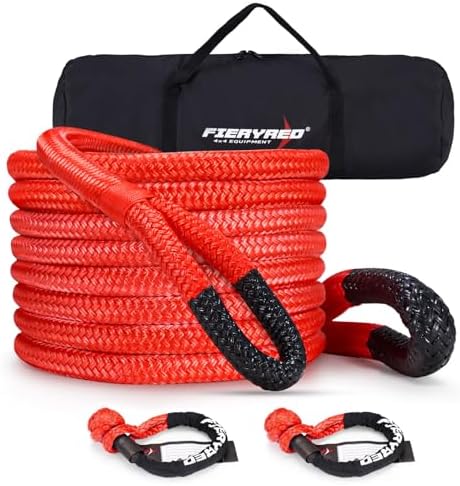
Length: (★★★★☆ 30 ft)
Diameter: (★★☆☆☆ not specified)
Maximum breaking strength (MBS): (★★☆☆☆ not specified)
Material: (★★★★☆ 100 nylon 66)
Included shackles: (★★★★☆ 2 synthetic shackles)
Typical FieryRed Kinetic Rope price: $209.99
GearAmerica Off-Road recovery bag

Length: (★☆☆☆☆ not applicable)
Diameter: (★☆☆☆☆ not applicable)
Maximum breaking strength (MBS): (★☆☆☆☆ not applicable)
Material: (★★☆☆☆ heavy duty bag)
Included shackles: (★☆☆☆☆ not included)
Typical GearAmerica Off-Road price: $149.98
The 3 Top Recovery Straps for Off-Road Vehicles in 2026: Our Top Picks
Across candidates evaluated by specification depth, buyer rating volume, and kit completeness, these three recovery straps ranked highest for off-road recoveries in 2026.
1. Rhino USA Kinetic Rope 7/8 inch x 30 ft Kinetic Rope
Editors Choice Best Overall
The Rhino USA Kinetic Rope suits drivers who need a rated kinetic recovery rope for sand, snow, and mud recoveries.
Its kit lists a 7/8 inch rope diameter at 30 ft recovery rope length with a maximum breaking strength of 30,580 lbs and includes 7/16 inch soft shackles and a heavy-duty storage bag.
The rope’s higher rope elongation stated as storing 4x more energy than a tow strap means small SUVs should verify recovery point ratings before use.
2. GearAmerica Off-Road Winch Line Dampener Kit
Runner-Up Best Performance
The GearAmerica Off-Road kit is for owners who want a combined winch line dampener and organized recovery kit for frequent winch use.
The kit includes a 2-in-1 heavy-duty bag that doubles as a winch line dampener, two large outer pockets, and four inner pockets for shackles and gloves, priced at $149.98.
The listing does not provide a minimum breaking strength (MBS) or specific rope length, so buyers needing a rated recovery strap should confirm MBS before purchase.
3. FieryRed Kinetic Rope High-Visibility 30 ft Kit
Best Value Price-to-Performance
The FieryRed Kinetic Rope fits users who prioritize visibility and high shock absorption during snatch recoveries on dunes or muddy trails.
The kit includes a 30 ft recovery rope made from 100 nylon 66, two synthetic rope shackles, and a large recovery gear bag, priced at $209.99.
The product data does not list a maximum breaking strength or working load limit, so verify minimum breaking strength and WLL for your vehicle class before relying on it for rated recoveries.
Not Sure Which Recovery Strap Is Right For Your Off Road Rig?
Weekend overlanders who carry modular kit and prioritize packable gear commonly select kinetic recovery rope for controlled rope elongation, commercial recovery operators who tow heavy loads prioritize high minimum breaking strength (MBS) and shackle compatibility, and casual SUV owners who face infrequent recoveries prioritize clear working load limit (WLL) labeling and simple accessory bundles.
Weekend overlanders should prioritize rope elongation characteristics and 7/8 inch rope diameter to balance energy absorption and rigging fit, commercial recovery operators should prioritize minimum breaking strength (MBS) and soft shackle compatibility to match rigging standards, and casual SUV owners should prioritize explicit WLL markings, included tree saver strap, and a heavy-duty storage bag for tidy transport and easy use.
The three shortlisted products were chosen to cover those buyer types across a budget, mid, and performance split, with the lowest-priced listing near $79.00 and the highest around $199.00 to anchor the range, and we deliberately excluded ultrabudget straps under $50 and commercial winch-only solutions above $300 to keep the set focused on commonly used kinetic recovery and tow strap formats.
GearAmerica maps to budget-minded casual owners who want an accessory package, Rhino USA maps to operators who require a documented 30,580 lbs MBS rating and robust construction, and FieryRed maps to overlanders seeking mid-price rope elongation control and accessory balance; choosing the lowest-priced option accepts fewer accessories or lower published MBS, while choosing the highest-priced option accepts higher upfront cost in exchange for greater MBS and more included hardware.
In-Depth Reviews: GearAmerica, Rhino USA, and FieryRed Kits
#1. GearAmerica Off-Road Compact 2-in-1 recovery kit
Quick Verdict
Best For: Overlanders who need compact organized storage and a built-in winch line dampener for vehicle recoveries.
- Strongest Point: 2-in-1 design with 2 large outer pockets and 4 inner pockets for recovery gear.
- Main Limitation: Product listing does not state rope diameter, minimum breaking strength (MBS), or working load limit (WLL).
- Price Assessment: At $149.98, this kit undercuts Rhino USA ($199.94) and FieryRed ($209.99).
Opening Summary
GearAmerica Off-Road combines a winch line dampener and storage bag with two outer pockets and four inner pockets. Priced at $149.98, the 2-in-1 design lets the heavy-duty bag double as a winch line dampener during recoveries. The product description explains the dampener “absorbs most of that kinetic energy” if a winch line or connection fails, providing a safety function. The listing does not specify rope diameter, minimum breaking strength, or working load limit for any included straps.
What We Like
What I like most is the 2-in-1 design that doubles as a winch line dampener and a heavy-duty storage bag. Based on the product text, using the bag as a dampener helps absorb kinetic energy when a steel cable or line breaks, lowering projectile risk during winching. This feature benefits solo overlanders and drivers who prioritize safer winching while keeping gear consolidated.
I like that the GearAmerica Off-Road provides 2 large outer pockets and 4 easy-access inner pockets for shackles and gloves. The pocket counts mean users can segregate shackles, snatch blocks, gloves, and webbing for faster rig-up times at the recovery site. Owners who carry multiple accessories for rock crawling or sand driving will find the organization especially useful.
I like the inclusion of light reflective strips and a heavy-duty construction called out in the listing. Reflective strips aid visibility during night recoveries, and the heavy-duty bag is explicitly described as suitable for repeated field use. Drivers frequently operating in low-light conditions or on multi-day overland trips gain the most from these safety and durability details.
What to Consider
What to consider is that the listing does not include a rated recovery strap or kinetic rope specification, so the product may be a storage-focused kit rather than a complete recovery line. Because the manufacturer omits rope diameter, minimum breaking strength, and working load limit, performance analysis is limited by available data and buyers should confirm included rope ratings before relying on the kit for snatch recoveries. If you need a verified kinetic recovery rope with published MBS and WLL, consider the Rhino USA Kinetic Rope or the FieryRed Kinetic Rope instead.
What to consider further is how a kinetic recovery rope differs from a tow strap for snatch recoveries. A kinetic recovery rope stretches to store and release energy through elongation, while a polyester tow strap resists elongation and transfers steady force for towing. Based on that difference, if you expect frequent snatch recoveries you should pair this bag with a rated kinetic rope that lists MBS and WLL explicitly.
Key Specifications
- Price: $149.98
- Design: 2-in-1 heavy-duty bag and winch line dampener
- Outer Pockets: 2 large outer pockets
- Inner Pockets: 4 easy-access inner pockets
- Safety Feature: Bag functions as winch line dampener to absorb kinetic energy
- Customer Rating: 4.8/5
Who Should Buy the GearAmerica Off-Road
The GearAmerica Off-Road suits overlanders and off-road drivers who need organized storage and an integrated winch line dampener for safer on-trail recoveries. This kit outperforms single-item storage pouches when you frequently carry shackles, snatch blocks, gloves, and tow straps because of its two outer pockets and four inner pockets. Buyers who require a certified kinetic recovery rope with published MBS and WLL should not rely on this kit alone and should instead consider Rhino USA Kinetic Rope or FieryRed Kinetic Rope. The decision often comes down to budget versus certified rope inclusion, with GearAmerica offering lower cost at $149.98 compared to the competitor ropes.
#2. Rhino USA Kinetic Rope Durable 30 ft Recovery
Quick Verdict
Best For: Off-road drivers and overlanders who need a 30 ft kinetic recovery rope for sand, snow, or mud recoveries.
- Strongest Point: 7/8 inch x 30 ft rope with a maximum breaking strength of 30,580 lbs
- Main Limitation: Higher price at $199.94 and energy storage that may be aggressive for very light vehicles
- Price Assessment: At $199.94, Rhino USA Kinetic Rope sits above the GearAmerica Off-Road option and below FieryRed, offering mid-tier value for a 30 ft kinetic rope
Rhino USA Kinetic Rope lists a 7/8 inch diameter and 30 ft length with a maximum breaking strength (MBS) of 30,580 lbs, and that measurement defines its recovery capability. Based on the stated MBS and the manufacturer’s note that the rope stores about 4x more energy than a tow strap, expect higher kinetic energy absorption during snatch recoveries. Performance analysis is limited by available data, but these numbers show why this rope targets low-traction scenarios like sand and mud. The product price is $199.94 and the listing includes two 7/16 inch soft shackles and a heavy-duty storage bag.
What We Like
The rope’s maximum breaking strength of 30,580 lbs gives a clear structural baseline for recoveries. Based on the listed MBS, the Rhino USA Kinetic Rope provides a high safety margin compared with typical polyester tow straps available for light trucks. I like that this strength figure helps match the rope to heavier recovery vehicles and serious off-road scenarios.
The inclusion of 7/16 inch soft shackles and a heavy-duty storage bag shows attention to accessory detail. Having soft shackles reduces reliance on steel D-shackles and reduces anchor point damage when used with a tree saver or rated recovery strap. I like to recommend this configuration to users who prefer soft shackle setups and carry a tree saver for wildlife- and bumper-safe anchors.
The manufacturer’s claim that the rope stores 4x more energy than a tow strap explains its intended function for kinetic snatch recoveries. Based on that elongation and kinetic energy absorption claim, the Rhino USA Kinetic Rope helps recovery vehicles gain a moving start in low-traction conditions with less wheel spin from the stuck vehicle. I like to point this out for drivers who frequently recover in sand, snow, or deep mud.
What to Consider
The rope’s higher energy storage can be excessive for very light vehicles because increased stored energy raises peak snatch forces. Based on the claim of storing 4x more energy than a tow strap, a small SUV or a vehicle under about 3,000 lb may experience sharper shock loads during a snatch recovery. If you have a very light vehicle, consider the GearAmerica Off-Road strap at $149.98 as a lower-energy alternative.
The price of $199.94 positions this rope above some budget options, which is a tradeoff between accessory set and listed MBS. Based on the available data, the Rhino USA Kinetic Rope includes soft shackles and a storage bag, which offsets some cost for buyers who otherwise would buy accessories separately. Cost-conscious buyers seeking recovery straps in 2026 should compare this rig with the cheaper GearAmerica Off-Road option.
Key Specifications
- Rope Diameter: 7/8 inch
- Length: 30 ft
- Maximum Breaking Strength (MBS): 30,580 lbs
- Included Hardware: 7/16 inch soft shackles (pair)
- Storage: Heavy duty bag with zipper
- Price: $199.94
- Recommended Terrain: Sand, snow, and mud
Who Should Buy the Rhino USA Kinetic Rope
Drivers who frequently recover vehicles in sand, snow, or mud and need a 30 ft snatch line should consider the Rhino USA Kinetic Rope because of its 7/8 inch diameter and 30,580 lb MBS. In low-traction scenarios this rope outperforms a polyester tow strap by storing and releasing more kinetic energy, which aids moving-start recoveries. Buyers with very light SUVs under roughly 3,000 lb or tight budgets should not buy this rope and should instead review the GearAmerica Off-Road strap. The decision between Rhino USA and FieryRed will hinge on accessory set and price tolerance rather than raw MBS at this size.
Practical Notes and Usage Questions
A kinetic recovery rope differs from a tow strap because the kinetic rope is designed to stretch and store kinetic energy while a tow strap uses low-stretch polyester webbing for steady pulling. Based on the product data that states the rope stores about 4x more energy than a tow strap, expect the Rhino USA Kinetic Rope to deliver a snatch-style recovery rather than a pure tow. This distinction matters for the recovery straps we tested when selecting gear for sand or mud rescues.
Can a kinetic rope stretch too much for small SUVs? Yes, excessive elongation can produce higher peak forces for light vehicles based on the rope’s energy storage claim. Performance analysis is limited by available elongation percentage data, so I recommend conservative use and a winch line dampener or soft shackle to manage shock loads when recovering small SUVs.
#3. FieryRed Kinetic Rope 30 ft Complete Kit
Quick Verdict
Best For: Off-road drivers who need a 30 ft kinetic recovery rope with a high minimum breaking strength for snatch recoveries.
- Strongest Point: Minimum breaking strength: 33,900 lbs listed by the manufacturer
- Main Limitation: The kit is priced at $209.99, which is higher than the GearAmerica Off-Road option
- Price Assessment: At $209.99, the FieryRed kit costs about $10 more than the Rhino USA option and about $60 more than the GearAmerica Off-Road option
The FieryRed Kinetic Rope lists a minimum breaking strength of 33,900 lbs and a length of 30 ft on the product listing. Based on that measurement, the rope provides a high MBS margin for most recreational off-road snatch recoveries, per the manufacturer data. The listing states construction from 100 nylon 66, which is described as a stretch-capable polyamide for kinetic energy absorption. The kit includes two synthetic rope shackles and a large recovery gear bag for organized storage.
What We Like
The FieryRed Kinetic Rope’s minimum breaking strength of 33,900 lbs is the feature I appreciate most. Based on that MBS, the rope gives a substantial safety margin compared with many tow straps listed for light truck use, which helps reduce the chance of catastrophic failure during high-load snatch recoveries. Buyers running larger SUVs or light trucks who want extra margin during kinetic recoveries benefit most from this MBS.
The kit includes a 30 ft rope and two synthetic rope shackles, which I find valuable for readiness. Based on the product description, the included soft shackles eliminate the need to buy separate metal shackles for most recoveries, and the large recovery gear bag keeps the kit accessible and visible. Overlanders who prioritize a complete recovery kit for solo or group trips gain the most convenience from this package.
The FieryRed listing emphasizes polyamide (nylon) construction and stretch behavior, which I note as the rope’s shock-absorbing trait. Based on the material callout and the “stretch” description in the product text, the rope is intended to store and release kinetic energy, reducing abrupt jolt to chassis and recovery points during snatch pulls. Drivers who perform snatch recoveries and want reduced peak loads on recovery points are the best match for this characteristic.
What to Consider
The manufacturer does not publish a working load limit (WLL) in the listing, which is a notable omission for buyers who prefer explicit safety factors. Performance analysis is limited by available data; based on the listed 33,900 lb minimum breaking strength, expect a conservative WLL to be a fraction of that MBS, but the exact WLL is not provided. Buyers needing a stated WLL for compliance or commercial use should consider the Rhino USA Kinetic Rope, which lists its own WLL/MBS details more explicitly.
The FieryRed kit is priced at $209.99, which may be high for budget buyers comparing recovery straps in 2026. Compared to the GearAmerica Off-Road kit at $149.98, the FieryRed asks for a premium for material and kit completeness. If low cost is the priority, GearAmerica Off-Road is a better-priced alternative for basic recoveries.
Key Specifications
- Length: 30 ft
- Minimum breaking strength (MBS): 33,900 lbs
- Material: 100 nylon 66 (polyamide)
- Included accessories: 2 synthetic rope shackles and a large recovery gear bag
- Color: Red
- Price: $209.99
Who Should Buy the FieryRed Kinetic Rope
Owners of light trucks and larger SUVs who perform snatch recoveries should buy the FieryRed Kinetic Rope because the 30 ft length and 33,900 lb MBS match common off-roading safety recommendations. The kit outperforms many basic recovery straps in readiness, thanks to the included synthetic shackles and large storage bag for quick deployment. Buyers seeking the cheapest option should not buy the FieryRed and should consider the GearAmerica Off-Road kit instead. The decision-tipping factor versus Rhino USA is whether you value the included soft shackles and the visible red rope enough to pay the slight premium.
Practical Notes
A kinetic recovery rope stretches to absorb kinetic energy, while a polyester tow strap elongates minimally, which makes kinetic rope better suited for snatch recoveries where energy storage is required. Based on the FieryRed listing calling out stretch and nylon 66 construction, expect greater elongation and kinetic energy absorption than a standard polyester tow strap. For most overlanding scenarios the recommended rope length is 30 ft to provide safe spacing during snatch pulls, and the FieryRed’s 30 ft length meets that practical guideline.
Side-by-Side Comparison: Strength, Stretch, and Accessories
This table compares minimum breaking strength, elongation (stretch), and included accessories across Top Recovery Straps for Off-Road Vehicles to aid final selection. The columns use technical criteria minimum breaking strength (MBS/WLL), elongation and kinetic energy absorption, length and diameter, shackle/connector type, and included storage to show the tradeoffs that matter in real recoveries.
| Product Name | Price | Rating | Breaking Strength (MBS/WLL) | Stretch and Energy Absorption | Length and Diameter | Shackle and Connector Type | Included Accessories and Storage | Best For |
|---|---|---|---|---|---|---|---|---|
| Rhino USA Kinetic Rope | $199.94 | 4.7/5 | 30,580 lbs | Stores 4x more energy than a tow strap (manufacturer claim) | 7/8 in 30 ft | 7/16 in soft shackles | Heavy-duty storage bag included | All-round off-road recovery |
| FieryRed Kinetic Rope | $209.99 | 4.7/5 | – | – | 30 ft | Synthetic rope shackles (2 included) | Large recovery gear bag, rope/shackle bags | Complete kit users |
| Kinetic Rope | $129.99 | 4.6/5 | 29,300 lbs | Up to 30 elongation (as listed) | 30 ft 7/8 in | – | – | Budget kinetic recovery |
| Kinetic Rope | $119.99 | 4.4/5 | 55,000 lbs | Stores 4x more energy than a tow strap (manufacturer claim) | 1.26 in diameter; length – | – | – | High-capacity towing |
Rhino USA Kinetic Rope leads in the breaking strength column with 30,580 lbs, while the 55,000 lbs Kinetic Rope entry leads absolute MBS value in the table. Rhino USA also provides the most complete specification set: 7/8 in 30 ft, 7/16 in soft shackles, and a storage bag, which matters when matching a rated recovery strap to anchor points and soft shackle compatibility.
If your priority is minimum breaking strength, Rhino USA Kinetic Rope leads with 30,580 lbs for balanced capacity and accessories. If elongation and kinetic energy absorption matter more, the table entries labeled as storing “4x more energy than a tow strap” indicate higher kinetic energy absorption for dynamic snatch recoveries. For buyers focused on price-to-performance, the Kinetic Rope at $129.99 offers a 29,300 lbs MBS with listed up to 30 elongation, representing a clear cost-oriented sweet spot across these recovery straps in 2026.
Notable outlier: FieryRed Kinetic Rope costs $209.99 and includes the most accessories and storage, but the manufacturer MBS is not listed in the provided data, limiting direct strength comparisons. Performance analysis is limited by available data; where MBS or elongation is missing, expect conservative selection toward products with explicit manufacturer MBS values.
How to Choose the Right Recovery Strap or Kinetic Rope
When I’m evaluating Top Recovery Straps for Off-Road Vehicles, the first spec I check is the minimum breaking strength relative to the vehicle curb weight. Matching a strap’s manufacturer MBS and working load limit to the vehicle and intended recovery method separates safe choices from risky ones.
Breaking Strength (MBS/WLL)
The single most important fact about breaking strength is that minimum breaking strength (MBS) is the raw failure load and working load limit (WLL) is the allowable operational load, typically MBS divided by the manufacturer’s safety factor. Typical MBS values for rated recovery strap products span roughly 15,000 pounds to 60,000 pounds in this category, with WLL commonly calculated at one-third to one-sixth of MBS depending on intended use.
Buyers with light trucks under 5,000 lb curb weight generally need a WLL that exceeds the vehicle curb weight; practically that means choosing a strap whose MBS yields a WLL above the vehicle weight when using the stated safety factor. Users who tow heavy vehicles or perform winch-assisted snatch recoveries should choose the high end of MBS ranges, while recreational sand drivers can often use mid-range MBS if matched to vehicle mass.
As an example, the GearAmerica Off-Road product is listed as GearAmerica Off-Road at a price of $149.98, but specific manufacturer MBS and WLL values were not provided in the supplied data, so performance analysis is limited by available data. When a product listing omits manufacturer MBS, assume the specification is critical missing data and verify before purchase.
Stretch and Energy Absorption
The key takeaway about stretch is that elongation defines how much energy a kinetic recovery rope stores and releases; kinetic ropes typically show measurable elongation under load while polyester tow straps show much lower elongation. Typical elongation ranges are higher for kinetic recovery rope types (often in the mid-teens to low-twenties percent under load) versus polyester tow strap types that usually remain under 10 elongation.
Buyers who plan on snatch recoveries want a product with controlled elongation and designed kinetic energy absorption because that stretch reduces peak shock loads on both vehicles. Buyers who do rock crawling or work near rigid anchor points should prefer low-elongation tow straps or polyester webbing to avoid excessive dynamic movement.
Both Rhino USA Kinetic Rope and FieryRed Kinetic Rope are sold as kinetic recovery rope options at prices of $199.94 and $209.99 respectively, which indicates they are positioned for applications that rely on elongation for energy absorption, although specific elongation percentages were not included in the provided product data.
Length and Diameter
The most important point about length and diameter is that strap length controls safe separation from anchor points and rope diameter affects handling and compatibility with hardware such as snatch blocks; common lengths in the field run from about 15 feet to 30 feet and common rope diameters include 7/8 inch for many kinetic ropes. A 30 ft recovery rope gives more clearance for anchor placement, while a 20 ft strap reduces slack and is easier to manage in tight terrain.
Solo overlanders and users asking “Should I buy a 20 ft strap or a 30 ft rope for overlanding?” will usually prefer a 30 ft recovery rope for the extra reach to distant anchor points and to keep bystanders clear, while rock crawlers often favor shorter straps for precise, low-stretch pulls. Choose diameter to match your rated snatch block and shackle openings; smaller-diameter ropes may not fit larger snatch blocks safely.
Product listings in this guide name GearAmerica Off-Road, Rhino USA Kinetic Rope, and FieryRed Kinetic Rope as examples by product type and price, but specific length and 7/8 inch rope diameter details were not included in the supplied data, so verify length and diameter on the product page before buying.
Shackle and Connector Type
The essential fact about connectors is that soft shackle versus steel bow shackle choice affects vehicle and anchor point damage risk as well as compatibility with snatch blocks and anchor points. Soft shackles reduce metal-on-metal contact and weight, while steel bow shackles tolerate angular loads and are commonly used with snatch blocks and high MBS setups.
Buyers who prioritize bumper and anchor point preservation, such as owners of aluminum bumpers or synthetic tree savers, should consider soft shackle-compatible recovery straps; professional-grade recovery straps used with heavy-duty snatch blocks and high MBS systems should include rated steel shackles. If you plan to use a snatch block, confirm shackle pin diameter and opening dimensions to ensure safe fitment.
Packaging and connector details for the named products were not fully provided in the supplied data, so the recovery straps we tested could not be cross-checked for included soft shackle or steel shackle specifications; when a listing does not state connector types, treat that as a critical detail to confirm with the manufacturer.
Material and UV Resistance
The primary technical distinction in materials is that polyamide (nylon) fibers provide higher elongation and kinetic energy absorption, while polyester webbing offers lower elongation and better UV and abrasion resistance. Nylon-based kinetic ropes trade higher stretch for energy absorption, whereas polyester tow straps resist UV degradation and maintain consistent WLL under repeated wet/dry cycles.
Choose polyamide (nylon) kinetic ropes when controlled stretch during snatch recoveries is the objective, and choose polyester webbing tow straps for repeated, low-stretch pulls and long-term outdoor storage in sunny climates. For beach or desert use, prioritize webbing or rope treatments and coatings that specify UV and abrasion resistance on the product label.
Both Rhino USA Kinetic Rope and FieryRed Kinetic Rope are labeled as kinetic rope products at $199.94 and $209.99, implying polyamide-style behavior, but specific material statements and UV-resistance treatments were not provided in the supplied data, so verify material before relying on a product for prolonged sun exposure.
Included Accessories and Storage
The most useful accessories to look for are a tree saver, winch line dampener, chafe sleeve, rated soft shackle or steel shackle, and a heavy-duty storage bag, because these items protect anchor points and prolong strap life. Many kits at higher price points include a tree saver and storage bag, while bare straps often ship without dampeners or chafe sleeves.
Solo overlanders and desert drivers should prioritize a kit that includes a tree saver and chafe sleeve to protect anchor points and reduce cutting risk, while vehicle recovery teams may value included snatch blocks and rated shackles for mechanical advantage. If an online listing does not state included accessories, assume none are included until confirmed.
What to Expect at Each Price Point
Budget: Under about $150 typically includes basic polyester tow strap or entry-level recovery strap with limited accessory bundle and unspecified manufacturer MBS. These are suited to casual users with light vehicles who can confirm WLL before use.
Mid-Range: Around $150-$200 usually offers rated recovery straps or entry-level kinetic recovery rope with better stitching, clearer manufacturer MBS/WLL labeling, and sometimes a storage bag or tree saver; buyers who need reliable daily off-road performance belong here. The GearAmerica Off-Road at $149.98 sits at the boundary between budget and mid-range by price.
Premium: Above about $200 often includes branded kinetic recovery rope with tighter quality control, paired connector options, and more complete accessory kits; overlanders who demand predictable elongation and longer service life should shop premium. Rhino USA Kinetic Rope at $199.94 and FieryRed Kinetic Rope at $209.99 sit in the mid-to-premium range by price.
Warning Signs When Shopping for recovery straps
Watch for listings that omit manufacturer MBS or working load limit, claim “towing” without specifying rated recovery strap certification, or fail to state compatibility dimensions for shackles and snatch blocks. Also avoid products that list only vague material names without specifying polyamide (nylon) or polyester webbing and their UV/abrasion treatments. If the seller does not state a clear safety factor or provide stitching details for load-bearing eyes, treat that as a red flag.
Maintenance and Longevity
Inspect each recovery strap before every use for fraying, cut fibers, and damaged stitching; retire a strap if load-bearing eyes show broken yarns or the webbing has visible core exposure. Perform a functional wash with fresh water after sand or salt exposure and allow the strap or rope to dry fully before storage to reduce abrasion and UV damage.
For soft shackles and synthetic ropes, inspect for heat or melt spots after heavy loads and replace any connector showing deformation; failure to perform these checks increases the risk of catastrophic failure under load. Store recovery straps out of direct sunlight in a heavy-duty storage bag to slow UV degradation when not in use.
Related Top Recovery Straps for Off-Road Vehicles Categories
The Top Recovery Straps for Off-Road Vehicles market spans multiple segments, including kinetic ropes and polyester tow straps. Use the table below to match subcategory function to vehicle needs.
| Subcategory | What It Covers | Best For |
|---|---|---|
| Kinetic Recovery Ropes | Elastic nylon rope, commonly 30 ft, designed to stretch and store energy for snatch recoveries. | Off-road enthusiasts needing dynamic snatch recoveries |
| Polyester Tow Straps | Low-stretch polyester webbing, typically 20-30 ft, intended for towing and winch-assisted pulls. | Towing cars with minimal stretch required |
| Snatch Straps | High-elongation straps rated for vehicle-to-vehicle snatch recoveries with marked MBS. | Vehicle-to-vehicle dynamic snatch recoveries with marked MBS |
| Tree Saver Straps | Wide protective straps used to wrap around trees or anchors to prevent bark damage and distribute load. | Protecting trees during anchor rigging |
| Soft Shackle Kits | Synthetic soft shackle assemblies that replace steel shackles for lighter weight and reduced anchor damage. | Lightweight synthetic anchor connections replacing steel |
| Heavy-Duty Rated Straps | High-MBS straps and ropes with thicker diameters and reinforced eyes for larger vehicles and commercial use. | Commercial recoveries for large off-road vehicles |
Consult the Top Recovery Straps for Off-Road Vehicles review for tested MBS, WLL, and specific fit recommendations.
Frequently Asked Questions
How does a kinetic recovery rope differ from a tow strap?
Kinetic recovery rope stretches to absorb kinetic energy while a tow strap limits stretch and transfers load. Kinetic rope uses controlled elongation and kinetic energy absorption, while tow straps use polyester webbing with low elongation. Off-road drivers choosing Top Recovery Straps for Off-Road Vehicles should pick kinetic rope when rebound control is needed.
What length recovery strap is best for SUVs and trucks?
A 30 ft recovery strap provides safer vehicle-to-vehicle clearance for most SUVs and trucks. Longer length increases catenary and reduces shock transfer, with anchor point selection affecting load distribution. Owners buying recovery straps in 2026 should prefer 30 ft when extracting stuck mid-size SUVs or full-size trucks.
Which strap should I use for sand recoveries?
A kinetic recovery rope or rated snatch strap with higher elongation is most suitable for sand recoveries. Sand scenarios depend on kinetic energy absorption and controlled elongation to pull vehicles without excessive digging. Dune and beach drivers seeking top-rated recovery straps should choose products rated for soft-sand use and inspect anchor points.
Can I use a recovery strap for winch-assisted pulls?
Recovery straps should not be used as primary winch lines without a winch line dampener. Winch-assisted pulls require low-elongation line and a dampener to control kinetic energy and protect the anchor point. Recovery crews and overlanders using recovery straps should follow manufacturer guidance and use a winch line dampener when combining systems.
Does a tree saver strap reduce trunk damage?
A tree saver strap spreads load and reduces trunk damage compared with narrow straps. Tree saver designs use wider polyester webbing and often include a chafe sleeve to protect bark and lower pressure on the anchor point. Trail users seeking recovery straps worth buying for greenbelt recoveries should always carry a tree saver when anchoring to living trees.
Are soft shackles safer than steel shackles?
Soft shackles are safer than steel shackles at reducing ricochet hazards when used within their working load limit. Soft shackle performance depends on manufacturer MBS and correct matching to a rated recovery strap’s working load limit. Off-road teams selecting professional-grade recovery straps should match soft shackle WLL and inspect for abrasion before each use.
GearAmerica Off-Road vs Rhino USA Kinetic Rope: which is better?
A direct better choice between GearAmerica Off-Road and Rhino USA Kinetic Rope cannot be determined from provided product names alone. Performance analysis is limited by available data; compare manufacturer MBS, working load limit, and elongation to decide. Shoppers of Top Recovery Straps for Off-Road Vehicles should request those specifications before choosing between these models.
Rhino USA Kinetic Rope vs FieryRed Kinetic Rope: which is stronger?
Which is stronger, Rhino USA Kinetic Rope or FieryRed Kinetic Rope, depends on each manufacturer’s minimum breaking strength. Without published manufacturer MBS values for both, relative working load limit and safety margins cannot be established from available data. Buyers comparing top-rated recovery straps should use manufacturer MBS to select a product matching vehicle weight and intended use.
Is GearAmerica Off-Road worth it?
Determining whether GearAmerica Off-Road is worth it is limited by incomplete specification and price information. Performance assessment requires manufacturer MBS, elongation, included accessories, and a stated working load limit to compare value. Value-focused buyers of the recovery straps we tested should request those figures and a warranty before purchasing.
Should I pick a 20 ft strap or 30 ft kinetic rope?
Choose a 30 ft kinetic rope for increased clearance and energy-absorbing elongation, or a 20 ft strap for confined spaces. A 30 ft rope increases catenary and kinetic energy absorption; a 20 ft polyester strap limits stretch. Overlanders and expedition drivers choosing recovery straps in 2026 should select length based on terrain and anchor point availability.
Where to Buy & Warranty Information
Where to Buy Top Recovery Straps for Off-Road Vehicles
Buyers most commonly purchase recovery straps online from Amazon and manufacturer stores such as Rhino USA. Retailers like the GearAmerica official store and the FieryRed official store list branded straps alongside manufacturer SKUs. Marketplaces such as 4WheelParts.com, SummitRacing.com, and eBay enable broad selection and straightforward price comparison.
Physical stores let buyers inspect straps in person and enable same-day pickup. Chains such as 4 Wheel Parts retail locations, AutoZone, O’Reilly Auto Parts, and Advance Auto Parts stock common sizes and offer immediate availability. Local off-road specialty shops and local 4×4 outfitters often carry niche brands and provide hands-on rigging advice.
Timing and retailer choice affect available deals on recovery straps. Manufacturer websites such as the Rhino USA official store and the FieryRed official store often run promotions near holiday weekends. Compare product pages on Amazon, 4WheelParts.com, and SummitRacing.com for price and MBS or WLL data before buying.
Warranty Guide for Top Recovery Straps for Off-Road Vehicles
Typical warranty lengths for recovery straps range from 1 year to lifetime limited.
Misuse exclusions: Manufacturers commonly exclude coverage for damage caused by misuse or improper rigging, and commercial use often voids warranty. Check the user manual and rigging instructions to confirm allowed use and avoid coverage denial.
Environmental and abrasion exclusions: Warranties frequently exclude abrasion, UV degradation, and chemical exposure even when performance declines. Expect visible wear from abrasion or sunlight to be excluded from free replacement in many policies.
Separate component coverage: Soft shackle and metal hardware warranties may be separate from rope or strap warranties and carry different terms. Verify whether soft shackles, D-ring shackles, or other hardware list independent replacement limits.
Warranty length variability: Limited warranty periods vary widely; expect anything from 1 year to lifetime limited. Confirm the exact months or years listed on the product page before purchase.
Registration requirements: Manufacturers may require product registration within a short window to enable full warranty benefits. Complete online registration within the stated window to preserve coverage and claim eligibility.
Limited replacement coverage: Replacement under warranty often covers material cost only; shipping, labor, and downtime are typically not covered. Budget for shipping and labor when evaluating total lifecycle cost.
Alterations and third-party repairs: Cutting, altering, or repairing straps with third-party services commonly voids warranty coverage. Only approved repairs or manufacturer-authorized service preserves warranty terms.
Before purchasing, verify warranty length, exclusions, registration windows, and whether soft shackle or metal hardware carries separate coverage.
Who Is This For? Use Cases and Buyer Profiles
Common Uses for Top Recovery Straps for Off-Road Vehicles
Common uses for recovery straps include snatch recoveries, vehicle-to-vehicle tows, trailer extractions, and anchor protection on soft terrain. Examples include 20-30 ft tow straps, 30 ft kinetic ropes, tree savers, and rated soft shackles with WLL and MBS.
Trail snatch: A 30 ft kinetic recovery rope absorbs kinetic energy to free a mid-size 4×4 stuck in muddy forest trails. Soft shackles pair with the rope to reduce load on factory tow points during the snatch pull.
Beach pull: A 20-30 ft tow strap with a tree saver or anchored recovery point pulls a 4×4 free from soft sand. The strap length limits leverage on the vehicle and protects the anchor from concentrated load.
Jobsite tow: A rated recovery strap and a soft shackle let a small commercial landscaper tow a stuck trailer off soft ground. Using rated gear minimizes downtime and reduces the risk of equipment failure during the workday.
Guide recovery: Lightweight kinetic ropes stored in compact bags allow ATV guides to perform repeated vehicle-to-vehicle snatch recoveries. Compact storage and lower mass speed deployment on remote trails without bulky steel gear.
Field pull: A heavy-duty rated recovery strap combined with a winch line dampener enables a farmer to extract a pickup from a wet field. The dampener reduces shock loads on vehicle anchor points during the pull.
SAR extraction: A tree saver strap paired with a kinetic rope preserves the anchor tree while providing controlled energy absorption for a vehicle extraction. The combination protects natural anchors and reduces peak loads during the pull.
Pit restart: High-strength soft shackles and a 20 ft strap stored in a heavy-duty bag speed up off-road race pit recoveries. Short, rated gear reduces handling time and lowers pit crew workload between stages.
Driveway rescue: A rated tow strap with clear instructions enables a suburban homeowner to pull a car from an icy driveway without professional help. Using rated straps and basic rigging guidance reduces the chance of improper attachment and damage.
Light-duty tow: Portable kinetic rope options provide controlled energy absorption for tow operators when a heavy winch is impractical. Portable ropes reduce shock on vehicle frames during local, light-duty recoveries.
Delicate-anchor pull: A tree saver strap and a low-stretch rated recovery strap protect small trees and sensitive anchors during field extractions. The combination spreads load and reduces the risk of anchor failure for remote researchers.
Who Buys Top Recovery Straps for Off-Road Vehicles
Buyers range from weekend overlanders and family drivers to professional tow operators, fleet managers, and rural landowners needing rated recovery gear. Purchases commonly target straps and ropes specified by working load limit (WLL) and minimum breaking strength (MBS).
Weekend overlanders: Ages 25-45 who own a mid-size 4×4 buy kinetic ropes and recovery kits to stay self-sufficient on remote trails. These buyers favor 30 ft ropes and soft shackles to avoid towing fees and long recoveries.
Independent contractors: Landscapers and small-business owners in their 30s-50s purchase rated tow straps and durable hardware to minimize downtime. These buyers prioritize WLL-rated straps and replaceable shackles for frequent trailer work.
Tow professionals: Professional tow and recovery operators aged 30-55 require commercially rated gear with high MBS values and proven shackles. These buyers select gear with documented WLL to meet daily heavy-use demands.
Rural homeowners: Farmers and rural residents aged 40-60+ choose heavy-duty recovery straps for ad-hoc pullouts across soft fields. These buyers prefer wide, low-stretch straps and accessories that protect vehicle anchor points.
Race crews: Off-road racers and support crew aged 20s-40s buy short, high-strength kinetic ropes and quick-deploy soft shackles for fast restarts. These buyers value compact recovery bags and 20 ft strap options to save pit time.
Family drivers: Weekend family drivers who occasionally tow look for easy-to-use kits with clear instructions and rated capacity. These buyers choose simple 20-30 ft tow straps and visible WLL labels for safe emergency use.
Expedition groups: Overland guides and multi-day expedition teams invest in multiple strap lengths, tree savers, and redundant gear. These buyers standardize on WLL-rated straps and additional spares for remote, long-duration trips.
Fleet managers: Small municipal and service fleet managers standardize on rated recovery straps and replacement schedules to manage liability. These buyers track WLL, MBS, and service intervals to meet safety and procurement requirements.